
VANGUARDS- A Character Creation Framework
Frogman Fiction, #2

Frogman: A figure of liminality, with one foot in the water and the other on land. They operate in the margins—harbors at night, surf zones, and shadows. Places where advantage belongs to those who can read currents, wait, and act with surgical precision.
Fiction: Narrative prose or verse created from imagination rather than direct historical or factual record. Fiction is not falsehood; It is an essential psycho-technology created by humans to aid their fellows in surviving and thriving in the world.
We are going to go deep into fiction character creation in this post, so if that’s not your jam, no hard feelings.
Many writers resist structure, recoiling like a scalded cat at the the notion there should be any bounds on the creative process, for fear it constrains creativity. I’ve found the opposite: constraints often generate imaginative force. What follows is one framework, not the framework, for developing full-bodied characters that leap off the page.
Characters in fiction fail for predictable reasons: they lack an internal wound or misbelief about the world, pursue vague desires, or behave inconsistently. They don’t seem real. VANGUARDS is designed to prevent those failures by aligning moral tension, psychological history, embodiment, and voice.
Without further ado, let’s get into it.
VANGUARDS—A Character Creation Template
In the realm of Spirit, we will develop Virtues/Vices, Archetypes, and Needs.
V — Virtues/Vices: Your character’s moral center and signature temptation. What virtues do they exhibit under pressure, and which vices threaten to sabotage their lives?
A — Archetype: The timeless role or persona a character exhibits through their thoughts, feelings, and behaviors. For VANGUARDS, I use the Enneagram and Character Rose, but you can slide in any other archetypal list you prefer here.
N — Need: The deep, often unconscious lack that true growth must satisfy (belonging, forgiveness, worthiness). This is different from what they desire.
In the realm of Mind, we will focus on the concepts of Ghost, Untruth, and Attitude.
G — Ghost: The formative wound, loss, or debt from their history that still haunts them and shapes their defenses. Also known as the Shard in other storytelling frameworks.
U — Untruth: A misbelief born of the Ghost. Examples: I’m only safe if I control everything; Love always abandons me. Also known as a “Misframing” or a “Lie.”
A — Attitude: This is their default stance toward the world—the quick, habitual way they appraise people, risk, power, truth, and themselves. It drives snap judgments, priorities, and tone before they’ve “thought it through,” and it shows up in choices, body language, and speech.
In the Bodily realm, we will focus on the Rendition of the character, their Desire, and Speech.
R — Rendition: The outward portrayal of a character—appearance, attire, behaviors, objects. How a character shows up descriptively on the page/screen.
D — Desire: The concrete objective a character is chasing; what they want. The desire should be measurable and time-limited. It should have a specific “win” condition—either they can do it or not.
S — Speech: Voice, diction, rhythms, favorite metaphors, silence, tells.
Now, let’s dig in to each component.
VANGUARDS in Detail
V — Virtues/Vices:
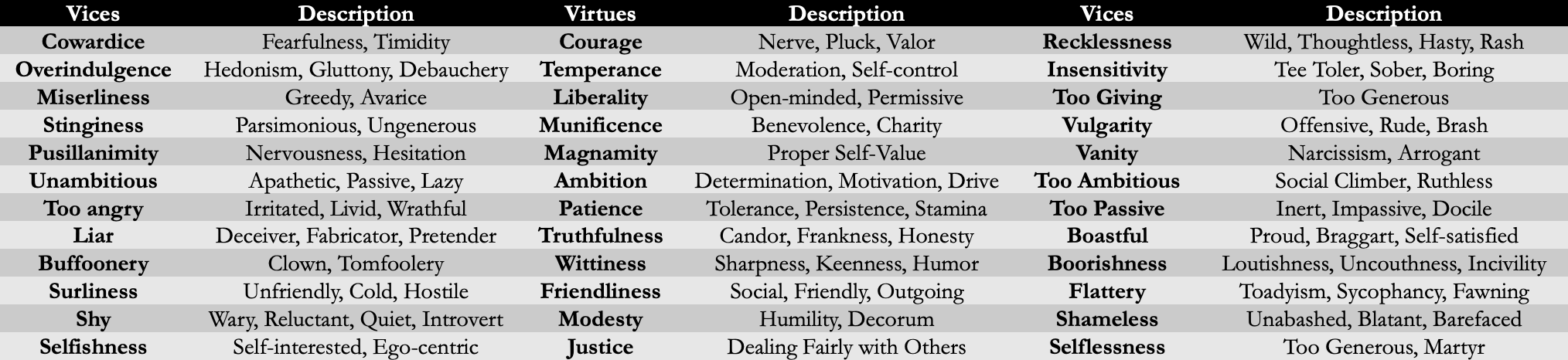
Apologies for the small font—I like having the virtues in the center and the vices on each side, to show the spectrum. I will upload a PDF at the end of this post that has these in list fashion.
This is the Aristotelian framing. Too little courage is cowardice, while too much is recklessness. As humans, we seek the Golden Mean but don’t always get there. That’s ok—our flaws make us interesting. As Brandon Sanderson says, Superman is interesting because of his vulnerability to Kryptonite. No vulnerability = Mary Sue character = BORING.
A — Archetypes:
Archetypes are defined as a universal, recurring pattern of character, symbol, role, or narrative that appears across myths, religions, stories, and cultures.
The Enneagram Archetypes reveal how someone creates an egoic persona by which to navigate the world. This would be difference than our true capitol S Self according to models like Internal Family Systems, but it is the face we present to the world.
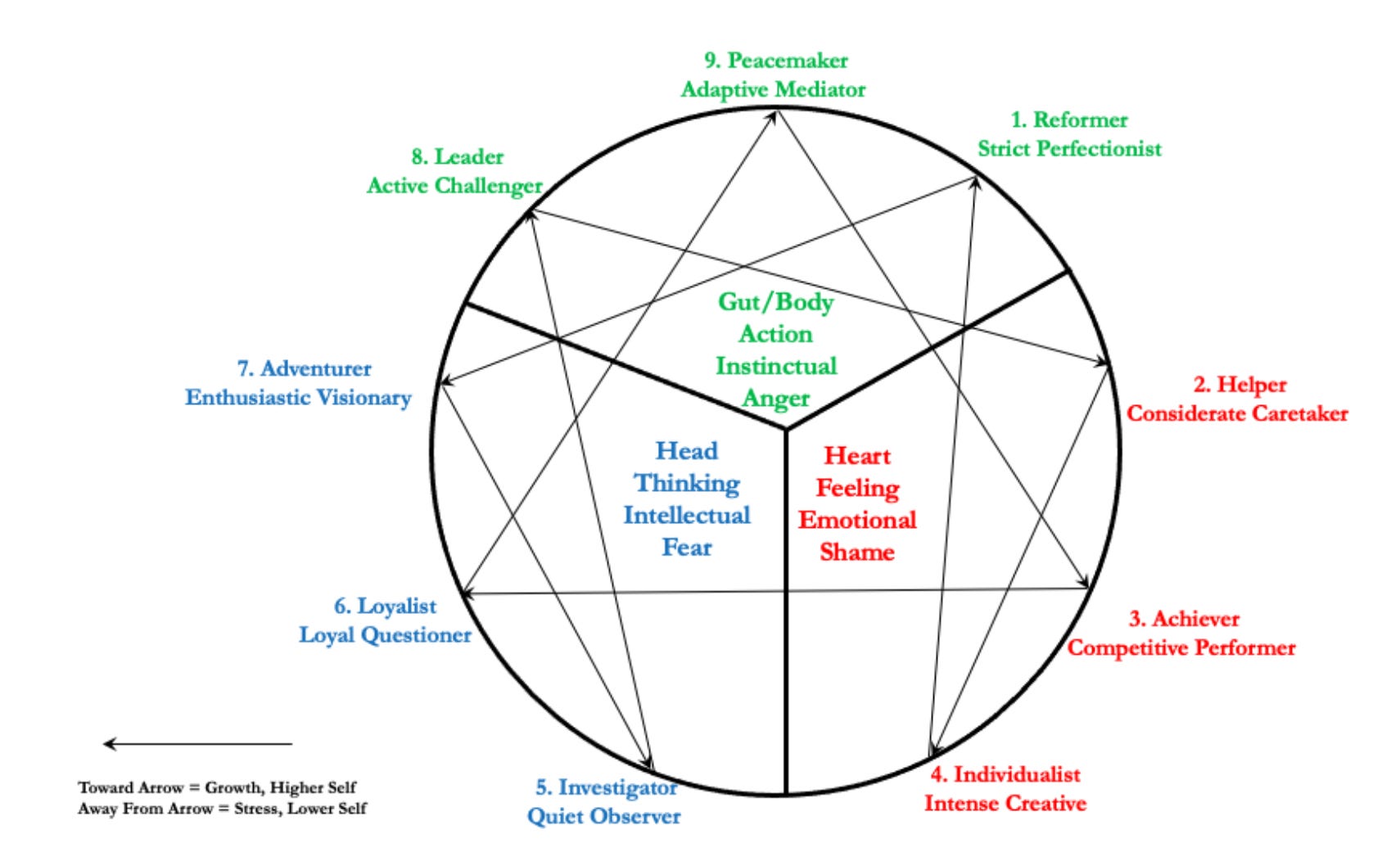
Note: The Enneagram has a high Woo rating, a la Tom Morgan. But even if you are skeptical about this model to describe humans in real life, it can still be valuable to create fictional characters. Here is a guide I put together from online resources and the entirely too many books on the Enneagram I have purchased over the years.

The Reformer - Perfectionist, principled, and self-controlled. They have a strong sense of right and wrong and strive to make the world a better place.
The Helper - Warm, generous, and nurturing. They often prioritize the needs of others over their own and seek to be needed and appreciated.
The Achiever - Driven, ambitious, and success-oriented. They strive to excel in their chosen fields and seek recognition and validation from others.
The Individualist - Creative, sensitive, and expressive. They often feel misunderstood and seek to express their unique identity and emotions.
The Investigator - Analytical, curious, and cerebral. They are focused on gaining knowledge and understanding complex systems and ideas.
The Loyalist - Committed, responsible, and cautious. They seek security and stability and often look to others for guidance and support.
The Enthusiast - Fun-loving, adventurous, and spontaneous. They seek stimulation and variety and often have a fear of missing out.
The Challenger - Assertive, confident, and protective. They are often driven by a desire for control and seek to stand up for themselves and others.
The Peacemaker - Easygoing, empathetic, and conciliatory. They seek to avoid conflict and create harmony in their relationships and environments.
Character Rose Archetypes
I developed the Character Rose from years of playing Table-Top Role-Playing Games (TTRPGs), as both player and Game Master. I wanted a genre-agnostic framework for character creation that works in a fantasy, sci-fi, or real world setting (Or what we think is the real world, anyway ;) ).
There are three classes—Doers, Thinkers, and Connectors. Each of these classes have three archetypes. Doers take action and accomplish skillful deeds. The Doer classes are Steward, Roughneck, and Seeker. Thinkers appreciate and pursue knowledge with relentless focus. The Thinker classes are Tinker, Chronicler, and Mystic. Connectors attend to other humans and emphasize favorable relations. The Connector classes are Diplomat, Merchants, and Healers.
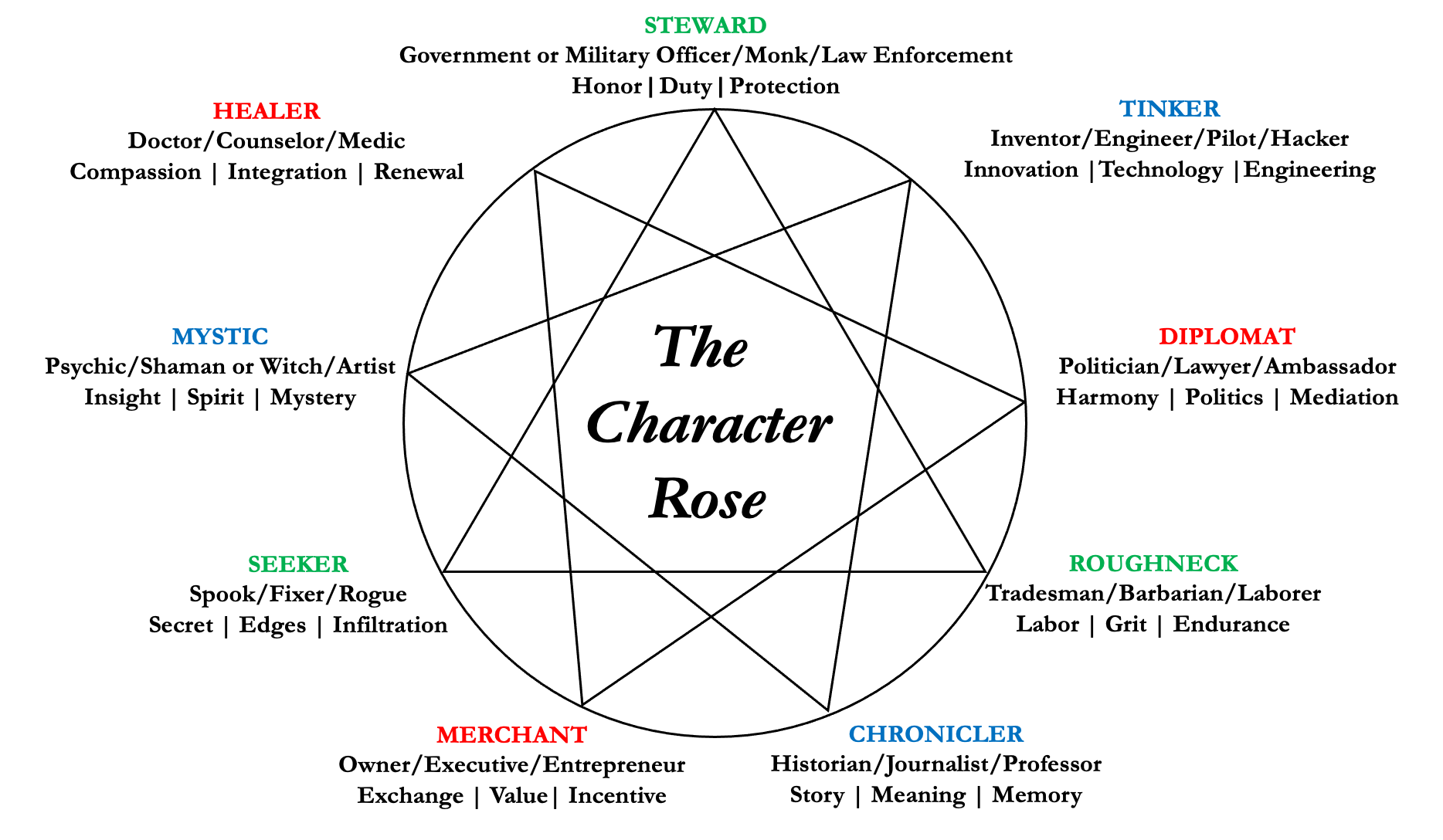
Here are the nine Archetypes of the Character Rose in a few sentences.
StewardThis is primarily an oath-bound profession, such as Paladins, Monks, Rangers, Military or Law Enforcement. A group that swears a sacred vow to uphold a particular value set.
Roughneck—A group who have a skilled trade, such as Blacksmithing, Farming, Firefighting, or Construction. They’re not afraid to get in the mix if you get crossways with them—they have a rugged and barbarian edge to them.
Seeker—These run the gamut from simple Spies, to Thieves, Criminals, Assassins, Private Investigators, and even Bards. They use silver tongues and nimble fingers to win the day.
Mystic—A Wizard, Mage, Shaman, Druid, Hacker, or Witch, those who learn the secrets of the world to master them. They want to find the seams in reality and exploit them.
Tinkerer— Inventors, Engineers, Scientists, and Pilots, these individuals want to innovate their way to a brighter future, if they can avoid exploding in the lab first.
Scholar—These seekers of ancient mysteries can be found plumbing the depths of history tomes, searching old ruins, or teaching at a university.
Diplomat— Negotiators, Judges, and Leaders, these individuals try to uphold the fabric of society and find non-violent solutions. Of course, they’re also ready if things get…kinetic.
Merchant—Entrepreneurs, C-Suite Executives, and Business owners. These are the people who keep the wheels of industry turning in the world.
Healer— Traditional Clerics as well as Surgeons, Paramedics, and Doctors/Nurses of all kinds, this group can save lives, and skilled in natural ways to take them.
This PDF combines the nine Enneagram and nine Character Rose types to create 81 different sub-archetypes.
N — Need. These are taken from Save the Cat! by Blake Snyder. Examples:
Forgiveness: of self or others.
Love: includes self-love, familial love, romantic.
Acceptance: of self, of circumstances, of reality.
Faith/Trust: In self, others, reality, in God.
Fear: overcoming it, conquering it, finding courage.
Survival: including the will to live.
Selflessness: including sacrifice, altruism, heroism, and overcoming greed.
Responsibility: including duty, standing up for a cause, accepting one’s destiny.
Redemption: including atonement, accepting blame, remorse, and salvation.
G — Ghost. A key event in their backstory. Examples:
Ignored a call; a parent died hours later.
Betrayed by a trusted partner; the team was ambushed.
Failed to protect a younger sibling in an accident.
U — Untruth. The wrong lesson they learned from this event, and how it makes them perceive things in a distorted fashion. Examples:
“I can’t trust anyone.”
“It’s all about me.”
“Loyalty above all.”
“I’m no good.”
“The measure of a man is his material possessions.”
“God will protect me if I’m worthy.”
A — Attitude. Examples:
Optimistic – quick to assume things will turn out well.
Skeptical – instinctively questions appearances and motives.
Defensive – anticipates threats or criticism, ready to guard against them.
Curious – approaches situations eager to explore and learn.
Cynical – expects selfishness or dishonesty from others.
Trusting – assumes good intent and reliability in people.
Pragmatic – focuses on what works rather than ideals.
Romantic – sees beauty, meaning, or destiny in events.
Combative – frames interactions as challenges to be met or contests to be won.
Playful – treats situations lightly, looking for humor or fun.
R — Rendition. Examples:
Eyes- Sleepy, Shifty, Watery, Bright, Cold, Smiling, Wild, Missing Eye, Lazy, Sharp.
Ears- Oversized, Small, Uneven, Long lobes, Hairy, Pointy, Sticking out, Red, Wrinkly, Cauliflower.
Mouth- Full/Buck teeth, Rotting/Crooked/False/Missing teeth, Cracked lips, Hangs open, Red, Cleft lip.
Nose- Crooked, Bulbous, Narrow, Button, Long, Broad, Angular, Round, Broken, Aquiline.
Chin/Jaw- Pronounced, Cleft, Rounded, Dimpled, Square, Sharp, Round, Underbite, Weak, Jowly.
Hair- Thick, Wavy, Wispy, Straight, Bald, Wiry, Oily, Short, Patchy, Long.
Other – High/tight/drawn cheekbones, Facial Hair, Acne, Mole, Freckles, Scarring, Open sore, Big forehead.
Height- Weirdly short, Short, Average, Above average, Unusually tall.
Body-Thin, Muscular, Obese, Lean, Gangly, Tiny, Flabby, Weak, Lumpy, Large.
Hands – Powerful, Soft, Callused, Light touch, Heavy touch, Nimble, Clumsy, Hairy, Scarred, Missing Fingers.
Smells – Fish, Garlic, Body Odor, Wet socks, Perfume, Clean, Sweaty, Exotic spice, Horrible/sweet breath.
Tattoo- Dagger, Name, Skull, Snake, Scorpion, Heart, Ring of thorns , Exotic Symbol, Dragon, Other.
Jewelry- Earrings, Necklace, Rings- Finger/Toe, Bracelet, Nose ring, Choker, Eyeglasses, Watch, Belt, Hairpin.
Attire- Crisp, Shabby, Fashionable, Faded, Torn, Tattered, Dirty, Old fashioned, Average, Expensive.
Demeanor- Nervous, Subtle, Feline, Blunt, Relaxed, Hand Talker, Stink Eye, Limps, Graceful, Withdrawn.
Objects—Weapons, Cars, special items.
D — Desire. These are like SMART goals. Examples:
Win the city council seat in the November election.
Steal the biotech prototype from the lab before midnight Friday.
Find and rescue his brother from the cartel safehouse within 48 hours.
S — Speech. Voice, diction, rhythms, favorite metaphors, silence, tells. Examples:
Diction: What words do they use? Emotional state? Culture? Education/Intelligence? Sex, Gender, Race, Age?
Style: Do they use flowing sentences or clipped, gruff words? Do they dramatize or speak with mechanical precision? Do they whisper, squawk, growl, or shout through a thick Boston accent? Use their hands?
Rhythm: How do their words flow together? Bounce their words around, or whisper and soothe like curling smoke, or blast you with a fire hose of non-stop words or trail off?
Catchphrases: Go-to sayings or words. They could have a default metaphor family, which is a way of expressing themselves based on where they grew up, their occupation, or some hobby or aspiration.
Default reaction to conflict: Blush/go silent? Get mad/push back? Respond calmly and boil on the inside? Flare up at first, then calm down/apologize? Give the benefit of the doubt/hold space? Judge immediately/feel offended? Do they have a forward emphasis, focusing on the future, a backward emphasis, focusing on the past, or a lateral emphasis, focusing on the present/reaching out to others for support in conflict)?
Sound: Loud, soft, breathy, brittle, croaky, smoky, flat, grating, gravelly, honeyed, hoarse, high-pitched, guttural, low, nasal, raucous, shrill, silvery, small, strident, taut, wheezy, booming, quavering.
Let’s put Bruce Willis’ portrayal of John McClane in Die Hard through VANGUARDS and see what he looks like under the hood.
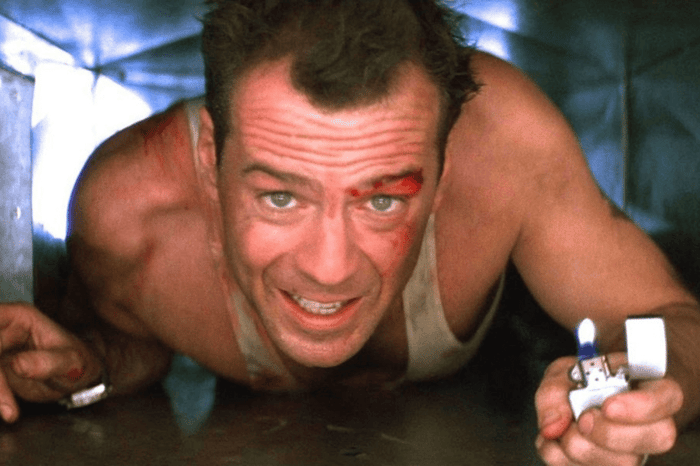
For Virtues and Vices, McClane is courageous but boorish. He reads as an Enneagram 8, and on the Character Rose I would put him as a Steward with notes of Roughneck. He needs to accept his wife’s needs and ambitions. This is best shown toward the climax of the movie, when battered and bloody, he asks Sargent Al Powell over the radio to find Holly and tell her, “John says he’s sorry.”
McClane’s Ghost is the way he and Holly fell out, and her move with their children to LA. From this emerges the Untruth: “If I’m not the primary breadwinner/protector, I am nothing.” This is where he derives his sense of worth. His Attitude is combative and pragmatic: McClane see the world as a place where threats are real, competence matters, and hesitation gets people hurt.
His Rendition on the screen reinforces the psychological journey he has to take: barefoot, bloodied, stripped of armor. McClane’s Desire is concrete and time-bound: stop the terrorists and save Holly. Finally, his Speech is plainspoken and wise-cracking, giving us no shortage of memorable lines.
In sum, John McClane is a proud protector forced into vulnerability, discovering that strength alone cannot save what he loves.
Here is the full framework in one PDF:
If you made it here, huzzah! I’d appreciate it if you like, restack, and pass it on to writer friends to spread the word.
Get Words / Accipere Verba
One of the beauties of fiction is it indirectly encourages readers to explore themselves. This post provides a framework to do the same. Character development applied.
Excellent. I found this enlightening in my dabbling with storytelling. It helped me see how to build strong characters who are alive. It is an art we should all try...."When the legends die.....there is no more greatness" (Tecumseh)